
Not every glamping experience in Peru follows the same format. Some journeys move with you across a trekking route, while others are built around a fixed location where the landscape becomes the main reason to stay.
This difference matters. A mobile glamping trek on the Inca Trail is designed around movement, logistics, and camp-to-camp progression. A luxury tented camp in places such as Tinajani, Colca, or the Sacred Valley is designed around stillness, scenery, and a deeper sense of place.
Understanding the difference between both formats can help travelers choose the right kind of outdoor luxury experience in Peru.
What Is Mobile Glamping in Peru?
Mobile glamping is a trekking-based experience where the camp moves with the route. This format is especially relevant on trails such as the Inca Trail, where travelers hike during the day and arrive at a new campsite each evening.
Unlike a standard trek, mobile glamping focuses on improving the overnight experience. Depending on the operator, this may include larger tents, better bedding, refined meals, hot showers, private service, and a more carefully organized camp setup.
The challenge is operational. Every camp must be assembled, moved, and rebuilt in remote conditions. For this reason, strong logistics are as important as design.
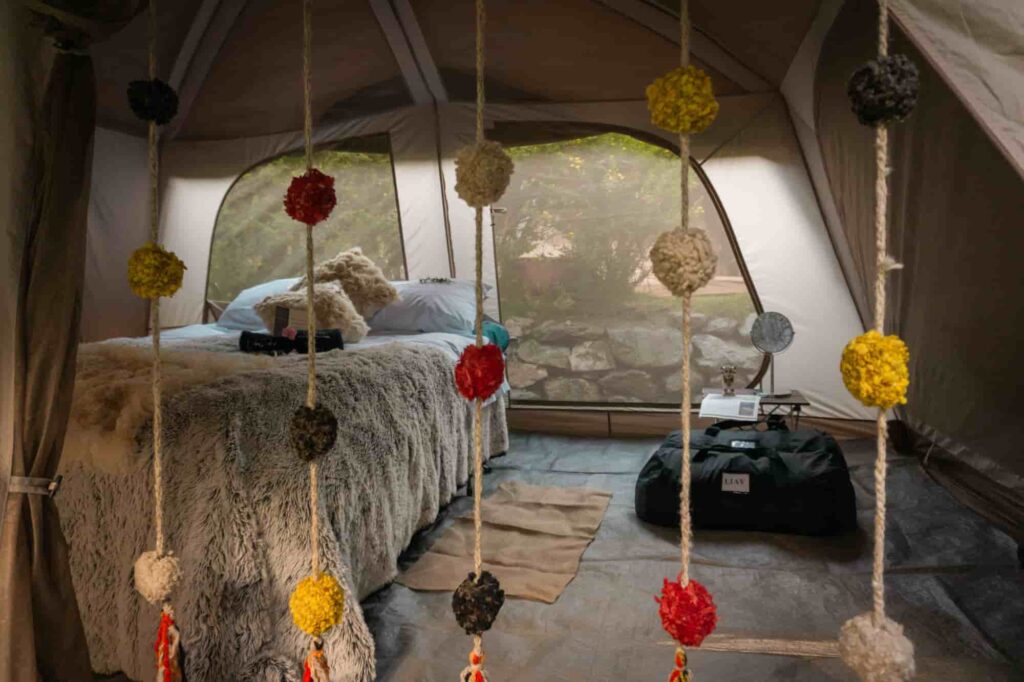
Best For: Inca Trail Glamping
The Inca Trail is one of the clearest examples of mobile glamping in Peru. The route itself remains active and demanding, but the experience is softened by a higher level of comfort at camp.
This format suits travelers who want the cultural and physical significance of the Inca Trail, but prefer a more refined trekking environment than traditional camping.
- Best for active travelers who still value comfort
- Ideal for private or premium trekking experiences
- Strong fit for travelers focused on Machu Picchu
- Requires good logistics and experienced trekking teams
What Are Luxury Tented Camps?
Luxury tented camps are usually fixed or semi-permanent stays set in a specific landscape. Instead of moving every night, travelers remain in one location and explore the surrounding area through guided walks, cultural visits, scenic routes, or quiet immersion.
This format allows for more developed comfort. Tented suites, private terraces, hot tubs, stronger bathroom infrastructure, refined dining, and more stable service can be easier to deliver when the camp is not moving daily.
In Peru, this style is especially relevant in remote or scenic destinations where the landscape itself is the experience.
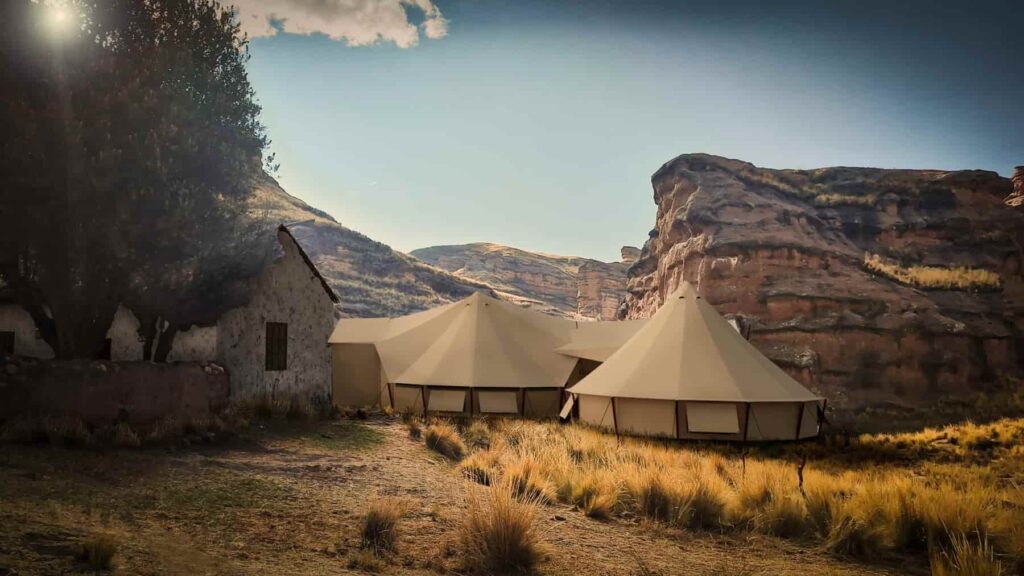
Best For: Tinajani, Colca, and Remote Andean Landscapes
Destinations such as Tinajani and Colca Canyon are well suited to luxury tented camps because they reward slower travel. These are places where the value is not only in reaching a final landmark, but in staying long enough to understand the atmosphere of the region.
A luxury tented camp in this context is less about completing a route and more about inhabiting a landscape with comfort, privacy, and intention.
- Best for travelers seeking remote scenery and privacy
- Ideal for couples, design-led travelers, and slow travel itineraries
- Better suited for lower-impact outdoor immersion
- Strong fit for extensions between Cusco, Puno, Colca, or Arequipa
Mobile Glamping vs Static Luxury Camps: Key Differences
| Feature | Mobile Glamping Trek | Luxury Tented Camp |
|---|---|---|
| Main Purpose | To support a trekking route | To experience one landscape deeply |
| Best Example | Inca Trail glamping | Tinajani, Colca Canyon, Sacred Valley |
| Comfort Level | High, but limited by trail logistics | Often higher due to fixed infrastructure |
| Travel Style | Active and route-based | Slower and place-based |
| Ideal Traveler | Adventure traveler seeking comfort | Luxury traveler seeking nature and privacy |
Which One Should You Choose?
Choose mobile glamping if the journey itself is the priority. If your goal is to walk the Inca Trail, reach Machu Picchu through the Sun Gate, and still enjoy a more comfortable camp experience, mobile glamping is the right format.
Choose a luxury tented camp if you want a slower outdoor stay with more privacy, stronger in-camp comfort, and time to connect with one destination. This works especially well in remote Andean settings, scenic valleys, canyon landscapes, or desert environments.
The best choice depends less on the word “luxury” and more on the rhythm of the trip you want.
How Outdoor Atlas Curates These Experiences
Outdoor Atlas evaluates mobile glamping treks and luxury tented camps differently because they are not the same type of product.
For mobile glamping, we look closely at route execution, camp logistics, trekking teams, safety, comfort, and how well the operator balances luxury with the demands of the trail.
For static tented camps, we focus on location, design, service level, privacy, sense of place, and how naturally the camp integrates with the surrounding landscape.
Final Perspective
Peru has the potential to become one of South America’s most interesting destinations for high-end outdoor stays, but the category needs clarity. Mobile glamping, luxury tented camps, scenic lodges, and premium trekking are often grouped together, even though they offer very different experiences.
For travelers, understanding these differences leads to better decisions. For Outdoor Atlas, this is exactly where curation matters: fewer options, better defined.
Request Curated Recommendations
If you are comparing Inca Trail glamping, luxury tented camps, or high-end outdoor stays in Peru, Outdoor Atlas can help you identify the format that best matches your travel style.