
Peru is a land of opportunity in the truest sense: the opportunity to experience vibrant, cosmopolitan cities; to encounter a history that spans millennia; and to journey through one of the most diverse geographies on Earth. From its dramatic coastline to the Andean highlands crowned with magnificent mountains, to the timeless wonder of Machu Picchu, and the lush rainforest nourished by the mighty Amazon River, the country offers a richness that is both natural and cultural.
How could one not see it as a place of endless possibilities, when it is also home to one of the world’s most celebrated culinary traditions? Welcome to this remarkable and beautiful land. Beyond this, there is much more to be appreciated; let’s see:
Peru, A land of Adventures
Few countries present such a striking range of environments within relatively short distances. In the Sacred Valley, broad agricultural terraces and mountain horizons create a setting that feels both expansive and grounded. Paths wind through villages and ancient sites, offering a sense of continuity between past and present.
Further along, routes such as the Inca Trail unfold gradually, combining physical challenge with historical depth. Each step carries a quiet sense of progression, where the landscape reveals itself with measured clarity.
What else?
Trekking journeys are often defined by the landscapes they cross—mountain passes, remote valleys, and quiet trails that unfold gradually over several days. Yet the experience is shaped just as much by how one rests along the way. In recent years, the distinction between traditional camping and glamping has become increasingly relevant, particularly in destinations such as Patagonia or along routes like the Inca Trail. Each approach offers a different rhythm, influencing not only comfort but also the overall connection to the journey.
Understanding traditional camping
Camping, in its most familiar form, is rooted in simplicity. It involves carrying or transporting essential equipment: tents, sleeping bags, and basic cooking supplies, while relying on minimal infrastructure. On trekking routes, this often translates into shared campsites set in open terrain.
The appeal lies in its directness. Evenings are shaped by practical routines: setting up tents, preparing meals, and adapting to changing weather conditions. There is a sense of participation in the environment, where comfort is secondary to presence. For many, this fosters a deeper awareness of surroundings, from the sound of wind across high-altitude plains to the gradual shift of light at dawn.
However, this approach also requires a level of physical readiness and adaptability. Altitude, temperature variations, and limited amenities are part of the experience. It is not designed to soften the landscape, but to engage with it as it is.
The concept of Inca Trail Glamping
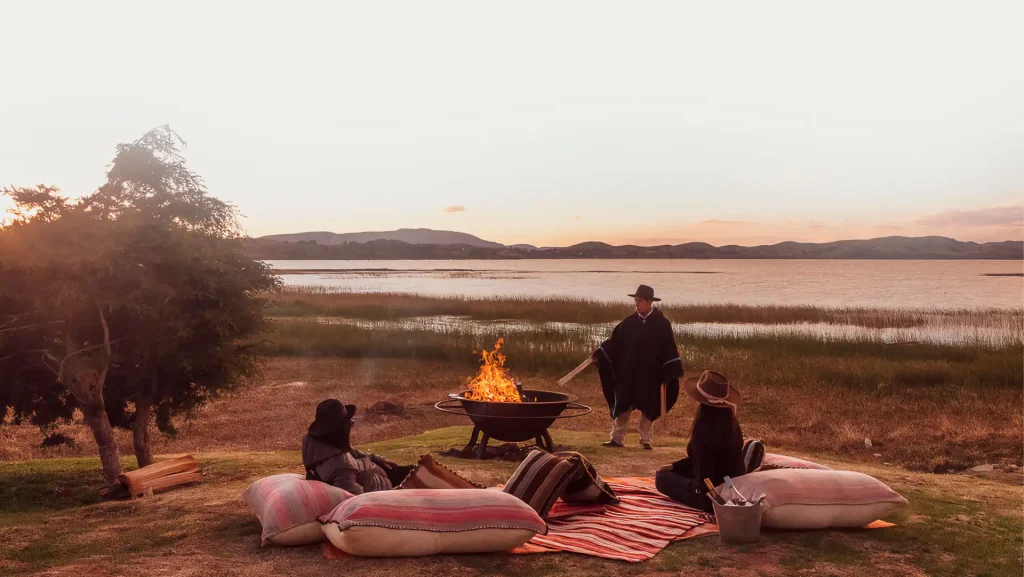
Glamping, short for “glamorous camping”, introduces a different perspective. While it maintains proximity to nature, it incorporates elements of comfort that are typically absent in traditional setups. On trekking routes, this may include pre-arranged tents, proper bedding, private or semi-private facilities, and carefully prepared meals.
In regions such as the Sacred Valley near Cusco, glamping has evolved into a thoughtful alternative for those who value both landscape and ease. Camps are often designed to blend with their surroundings, using materials and layouts that respect the environment while providing a more refined setting.
The experience tends to feel quieter and more structured. After a day of walking, returning to a prepared space allows for rest without the demands of setup or logistics. This shift changes the rhythm of the journey, making it less about endurance and more about continuity.
Comfort and physical demand
One of the most immediate differences between camping and glamping lies in the level of comfort. Traditional camping requires active participation in daily tasks, pitching tents, organizing gear, and adapting to limited facilities. While rewarding, it can add to physical fatigue, particularly on longer treks.
Glamping, by contrast, reduces these demands. Camps are typically arranged in advance, allowing travelers to focus on the walk itself rather than the logistics that follow. Beds, linens, and sheltered dining areas contribute to a more restorative environment.
This distinction becomes especially relevant in high-altitude regions. Routes such as the Ausangate Trek or the Salkantay Trek involve significant elevation changes, where rest plays a crucial role in overall well-being. In such contexts, the added comfort of glamping can influence how the body responds to the journey.
Connection to the Environment
There is often a perception that camping offers a more authentic connection to nature. Its simplicity encourages attentiveness, as travelers engage directly with their surroundings.
Glamping approaches this connection differently. Rather than removing comfort, it integrates it into the landscape. Thoughtfully designed camps aim to preserve views, silence, and spatial openness while offering a degree of shelter. The experience becomes less about exposure and more about balance.
Neither approach diminishes the environment; they simply frame it in distinct ways. For some, the rawness of camping enhances the journey. For others, the calm provided by glamping allows for a more reflective engagement.
Choosing the right approach
Selecting between camping and glamping depends less on preference alone and more on intention. Travelers seeking a physically immersive experience, where effort and environment are closely linked, may find camping aligns naturally with their expectations.
Those who value a more measured pace, with attention to rest and comfort, may find glamping offers a suitable alternative. It allows for engagement with the landscape without the additional strain of daily setup and minimal facilities.
Ultimately, the selection of the operator is of paramount importance. For those who seek a journey distinguished by the most attentive, bespoke service, where culinary excellence, restorative rituals following each day’s exertions, and moments of quiet preparation at dawn are harmoniously complemented by an exceptionally accomplished team and surroundings of refined elegance, the experience is elevated to an altogether different standard. In such a context, entrusting one’s journey to a globally esteemed trekking specialist ensures a level of precision, discretion, and excellence that defines a truly exceptional passage.